
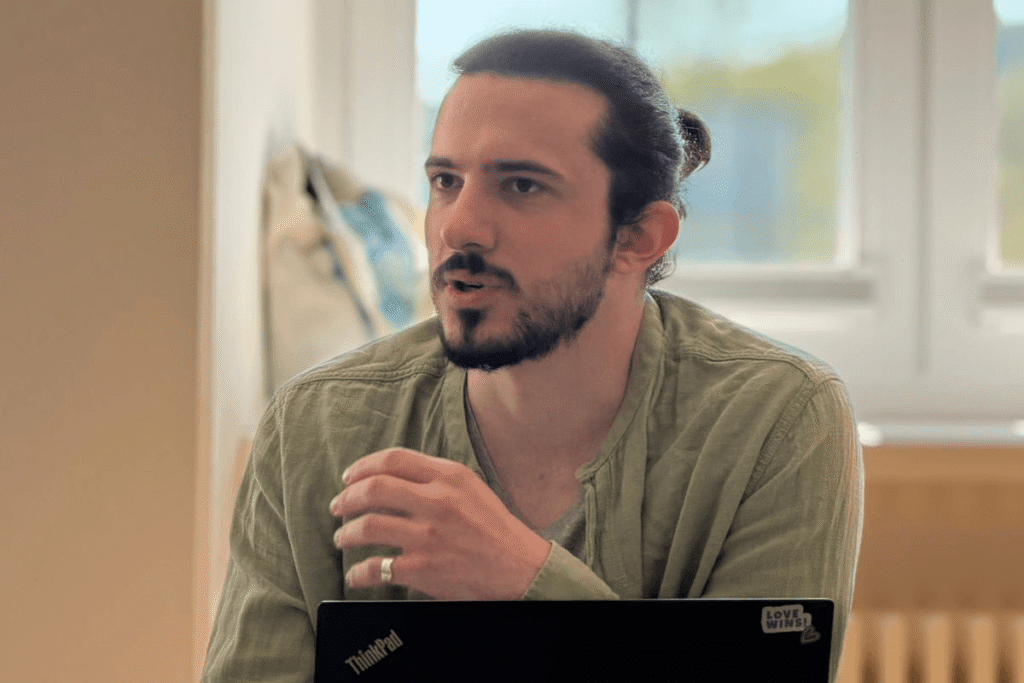
Within the framework of the sixth meeting of Georgian theologians abroad, on April 24th, 2026, in the German city of Eichstätt, PhD student Mate Saralishvili delivered a lecture on the following topic: “Trinitarian justifications of political theologies and the challenges they pose.”
The lecture addressed attempts by political structures to establish a direct connection with the theology of the Trinity. The issue was examined from both a theological and a historical-critical perspective.
On the one hand, the lecture discussed the positions held by Arius and Athanasius of Alexandria, Eusebius of Caesarea and Constantine the Great during the Council of Nicaea, and, on the other hand, around the Council of Constantinople the positions of Cappadocian Fathers and the Eunomians, of the Emperors Valens and Theodosius the Great, all those who had a direct or indirect influence on the formulation of Trinitarian theology. Furthermore, the speaker compared these events that took place in the fourth century and the positions taken by the political structures in relation to Trinitarian theology with following two significant theological debates that took place in the twentieth century: 1. the confrontation between Erik Peterson and Carl Schmitt over the relationship between Christianity and political theology, specifically, the attempt by Carl Schmitt to justify the political order of Nazi Germany through Trinitarian lenses, and its rejection by Erik Peterson. 2. Examples of Social Trinitarianism, beginning with the theology of Jürgen Moltmann, and the aporetic challenges arising within them.
Against the background of the consideration of different approaches to the theology of the Trinity during the history of Christianity, and the problems revealed in the attempts of political regimes to justify themselves on their basis, in the concluding section, the speaker discussed Trinitarian approaches of Paul S. Fiddes, John D. Zizioulas and Klaus von Stosch, which succeed in overcoming the challenges within the aforementioned political theologies by grounding themselves in the relational ontology of the Trinity, specifically, by linking the concepts of the mode of being, communion, and participation to a dynamic and life-giving experience, which aims at the transformation of the tropos of the person in communion with the Trinity. Most importantly, such an approach and vision can be formulated without projecting the contingent and historically determined political structures of humanity onto the immanent reality of the triune God, a danger that was clearly present in the authors discussed previously.
———-
Mate Saralishvili: He studied in the Liberal Arts program at Ilia State University, where he defended his bachelor’s thesis on the famous concept of the “numinous”, introduced by the German theologian, Rudolf Otto. He studied in the Religious Studies program at Ilia State University, where he defended his master’s thesis with distinction on the relational ontology of the Trinity in the Cappadocian Fathers and Maximus the Confessor. During his master’s, he translated Rudolf Otto’s book, “The Holy” (Das Heilige), from German into Georgian and published it with Carpe Diem Publishing House, for which he was awarded the Elizabeth Orbeliani Prize. As part of an exchange program, he studied at the University of Vienna, at the Faculty of Catholic Theology. Currently, he is writing his doctoral thesis at the University of Bonn in Germany, in the program for Religious Studies and Comparative Theology, where he is defending a thesis on relational ontology of the Trinity in interreligious dialogue.