
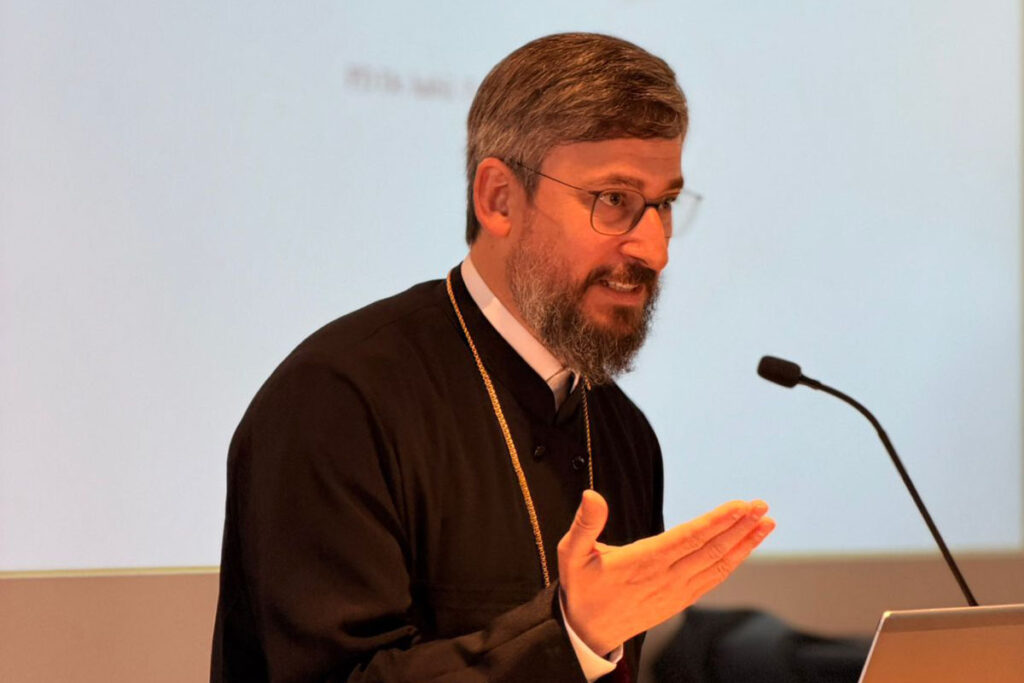
Igumen Dr. Ephrem Lomidze, in the German city of Eichstätt, delivered a lecture in German on the topic: “Anfänge des Christentums und der Kirche in Georgien. Historisch-theologische Analyse (The Beginnings of Christianity and the Church in Georgia. Historical-Theological Analysis),” within the framework of the sixth meeting of Georgian theologians abroad, at a symposium dedicated to the 1700th anniversary of Christianity in Georgia, on April 24, 2026.
The lecture addressed the establishment of the first ecclesiastical structure in Georgia. The question was not about when and which apostle preached Christianity in Georgia, but rather from which ancient ecclesiastical see the Church of Iberia received its first hierarchy, its episcopate.
It should be noted from the outset that St. According to Ephrem the Younger (11th century), Iberia, Christianized by St. Andrew the Apostle—whose account we first encounter in Georgian in the translations of Ekvtime Mtskhetaeli—after a certain time returned to paganism. Thus, in line with the theological understanding of the succession of the apostolic chain, St.According to Ephrem the Younger, the Iberia Christianized by St. Andrew the Apostle, which is first mentioned in Georgian in the translations of Ekvtime Mtskhetaeli, returned to paganism after a certain time. Based on Ephrem the Younger’s explanation that the Georgians, converted by St. Andrew the First-Called, reverted to paganism, And thus, in the 4th century, the need for a new ecclesiastical structure arose in Kartli; we must be dealing with a rupture in the episcopal structure for the transmission of saving grace in Georgia. This reconstruction by St. Ephrem the Younger becomes more understandable in the account of Bakur, which is found in Rufinus’s Historia ecclesiastica explains why King Mirian, in the 4th century, invited the clergy from Emperor Constantine the Great to establish a sacramental-mystical ecclesiastical life in Iberia. Precisely because the king cannot find the clergy in Iberia at the beginning of the 4th century.
Thus, the question of the present study is not whether an Apostle of the Lord was in Georgia, but rather how to theologically and historically explain this empty space. -explanation, or rather, the question concerns the broken link between the apostles of Jesus Christ and the hierarchy of the Georgian Church, and the historical truth of the restoration of this connection. A church is apostolic when it is founded directly by an apostle (what is called the direct apostolic foundation of a church), And a church is also apostolic when it inherits the structure of the ecclesiastical hierarchy from a see already founded by an apostle and continues its apostolic ministry through the episcopate (which is called the indirect apostolic foundation of the Church).
In light of this issue, more than 30 multilingual sources from the fourth to the twelfth century were examined in Latin, Greek, gathering materials on the establishment of the episcopal structure in Georgia in the Coptic-Sahidic, Armenian, Antiochian, and Old Georgian traditions. First, the sources were classified, and as a result of this systematization, five types of sources were identified, which made it possible to conduct a historically accurate and detailed analysis. Based on historical-critical and historical-theological methods, it was possible to demonstrate that the hierarchical origins of the Georgian Church – in accordance with the principle of a pure apostolic succession, is connected to the early Christian see of Antioch, which was headed by apostles, prophets, and teachers. After St. Andrew the First-Called, Iberia, which had reverted to paganism (about which the teaching was finally established by the decree of the local Council of Ruis-Urbisi (1103/1105) ]was reflected in the preface of the Council of Ephesus), historically regains its saving light through Antioch and, in a theological sense, becomes the successor to the succession of the founders of the Church of Antioch.
In this regard, St. Peter, the head of the apostles and brother of St. Andrew the Apostle, can be considered the beginning of our Georgian episcopate, along with the other apostles who personally labored in the land of Antioch and there established the apostolic see and the episcopal-hierarchical structure. Based on the theological understanding of apostolic succession, it is possible to reconstruct and present the relationship between Jesus Christ and the Georgian episcopate during the 1st – 4th centuries in the following way:
↓ Jesus Christ (in Jerusalem)
↓ The Apostles of Christ (Peter) along with others (Paul, Barnabas, and others) (in Antioch)
↓ Bishops as successors of the Apostles (in the Church of Antioch)
↓ (John, 4th century) the Bishop’s sending to Georgia (from the Church of Antioch)
↓ Establishment of the Church and its hierarchy (in Georgia)
↓ Bishops of the Church of Kartli and their successors to the present day.
The present thesis is subject to further academic analysis and evaluation, which it is hoped will take place in the future within Georgian theological discourse.
Efrem G. Lomidze, Doctor of Theology. For more information, see:
– https://www.step-wien.at/portfolio-item/dr-givi-lomidze/
– https://okk-ktf.univie.ac.at/ueber-uns/#c1028095
– https://iti.ac.at/fileadmin/user_upload/user_upload/Academic-Life/CV/Academic_CV_Ephraem_Givi_Lomidze_11.03.2026.pdf