
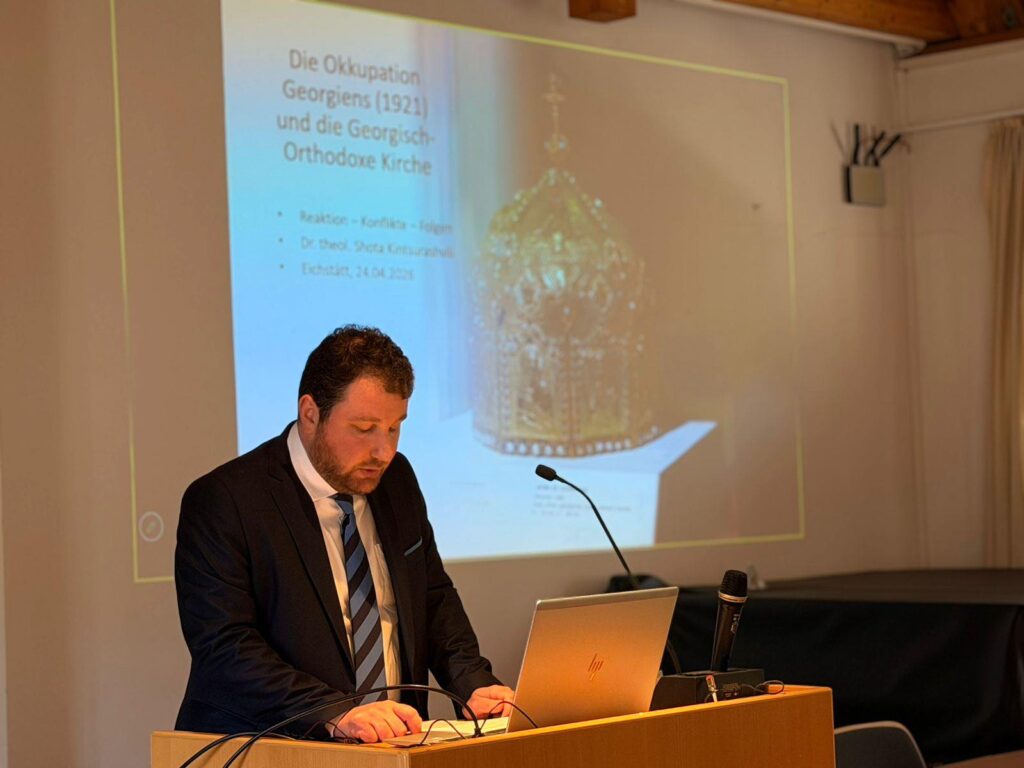
Dr. Shota Kintsuraishvili (Doctor of Theology) read a paper in German at a symposium dedicated to the 1700th anniversary of the declaration of Christianity as the state religion in Georgia, on the topic: The Occupation of Georgia by Bolshevik Russia and the Georgian Orthodox Church: Reaction and Consequences (Orig.: Die okkupation des unabhängigen Georgiens durch bolschewistisches Russland und die Georgisch-Orthodoxe Kirche: Reaktion und Folgen).
The presentation would address the challenges facing the newly restored (1917) autocephalous Georgian Orthodox Church after the first Republic of independent Georgia was occupied (1921). The main question of the presentation was: what was the Church’s reaction during the period of statehood loss and the Bolshevik takeover of power? The first forms of anti-church persecution and the Church’s response with a dispatch to the Genoa Conference, which resulted in the Orthodox Church being placed in full danger of physical annihilation. During this same period, two views existed within the Church regarding the Bolshevik regime: one was open confrontation, led by Ambrosi Khelaia and part of the Catholicosate Council. After a protest letter sent to the Genoa Conference, they were arrested and tried, The second group, on the other hand, was the effort by Metropolitan Christopher Tsitskishvili and his supporters to find ways to cooperate with the Bolshevik regime, with the aim of at least partially halting the persecution of the Church. How these two lines of ecclesiastical policy were viewed and what arguments supported them, a policy that ultimately concluded at the Fourth Church Council of 1927 with a declaration of public loyalty and cooperation toward the Bolshevik political regime.
This symposium was held at the University of Eichstätt-Ingolstadt in Germany as part of the sixth meeting of Georgian theologians abroad.
Shota Kintsurashvili graduated from the Tbilisi Theological Seminary in 2011. In 2015–2018, he studied at the University of Eichstätt-Ingolstadt in Germany, where he was awarded a Licentiate in Theology in the field of medieval and modern church history. In 2020–2025, he worked on his doctoral dissertation at the Ludwig-Maximilians University of Munich, Department of Christian Social Ethics. The topic of his dissertation is: “In Search of Orthodox Social Ethics Based on the Example of Georgia: A Theological and Sociological Analysis.” In 2026, he was awarded a Doctor of Theology degree (magna cum laude) from the same university. He is engaged in pedagogical and research activities in Germany and Georgia.